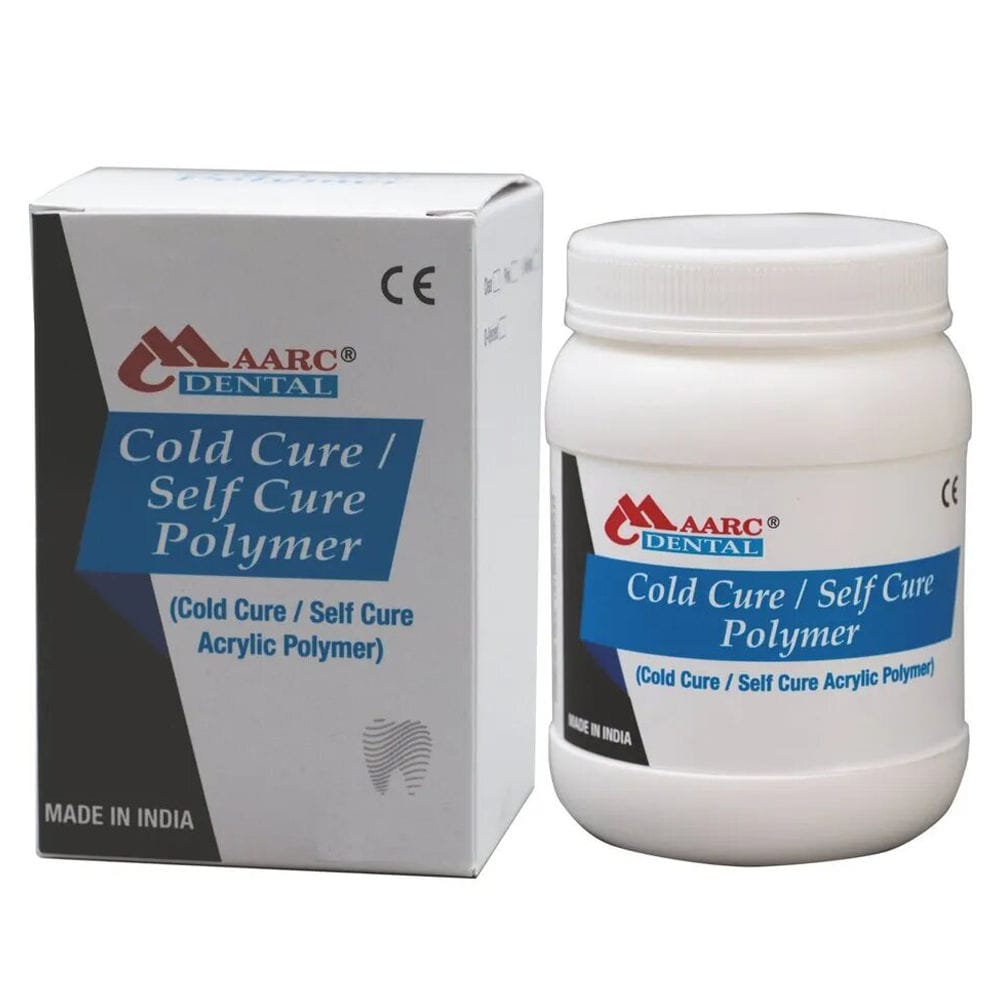
Maarc Cold Cure Self Cure Polymer represents an essential solution for dental professionals requiring rapid, reliable acrylic processing without specialized heat-cure equipment. As a self-polymerizing cold cure denture base material, it bridges the gap between emergency chairside needs and planned laboratory work, offering versatility that makes it indispensable in both clinical and laboratory settings. Whether you’re performing urgent denture repairs for distressed patients or fabricating custom orthodontic appliances, this proven material delivers professional-quality results through convenient chemical polymerization at room or body temperature.
Self-Polymerizing Acrylic Technology
Unlike conventional heat-cure acrylics that require flask processing and controlled heating cycles, Maarc Cold Cure utilizes chemical activation through powder-liquid mixing. When the polymer powder contacts the monomer liquid, an exothermic polymerization reaction initiates, converting the mixture from liquid to solid state without external heat application. This self-curing mechanism enables rapid fabrication and repair in situations where traditional heat processing is impractical, time-prohibitive, or equipment-unavailable.
Key Features
- Self-Polymerizing Formula: Chemical curing eliminates need for heat processing equipment
- Rapid Setting Time: Quick polymerization for efficient workflow and reduced wait times
- Room Temperature Cure: No specialized heating apparatus required
- Excellent Bond Strength: Superior adhesion to existing denture acrylic and metal components
- High Mechanical Strength: Durable repairs and fabrications withstand functional stresses
- Color Stability: Maintains shade consistency without significant discoloration
- Easy Mixing: Simple powder-liquid system with straightforward proportioning
- Versatile Applications: Suitable for repairs, relines, rebases, and orthodontic work
- Cost-Effective: Eliminates heat-cure equipment investment and energy costs
- Biocompatible: Safe for intraoral use with minimal tissue irritation
- Available in Multiple Shades: Color options for esthetic matching
Technical Specifications
- Product Type: Self-cure (cold-cure) acrylic resin system
- Presentation: Powder and liquid components
- Mixing Ratio: According to manufacturer instructions (typically 2:1 or 3:1 by volume)
- Working Time: 3-5 minutes at 23°C (varies with temperature and ratio)
- Initial Set Time: 8-12 minutes
- Complete Cure Time: 24 hours for maximum strength
- Curing Method: Chemical polymerization (self-cure)
- Polymerization Temperature: Room temperature to 37°C (body temperature)
- Flexural Strength: Comparable to heat-cure acrylics after complete polymerization
- Color Range: Pink tissue shades, clear, and tooth-colored options
Clinical and Laboratory Benefits
- Enables immediate chairside denture repairs without laboratory delays
- Eliminates patient inconvenience of extended denture absence
- Provides emergency repair capability for after-hours or weekend situations
- Reduces laboratory processing time and costs
- Offers versatile solution for diverse acrylic fabrication needs
- Supports same-day service for improved patient satisfaction
- Requires minimal equipment investment compared to heat-cure systems
- Allows direct intraoral processing for certain reline techniques
- Facilitates rapid orthodontic appliance fabrication and modification
- Delivers professional-quality results without specialized training
- Enables small-scale repairs without full denture reprocessing
- Provides economical alternative for budget-conscious practices
Comprehensive Applications
Denture Repairs: The primary application when you buy Maarc cold cure online is comprehensive denture repair work. This cold cure denture acrylic excels at:
- Fractured Denture Bases: Rejoining broken denture halves with strong, durable bonds
- Cracked Palates: Repairing midline and stress cracks in maxillary dentures
- Chipped or Broken Flanges: Rebuilding peripheral extensions and borders
- Tooth Replacement: Adding new denture teeth to existing prostheses
- Tooth Repositioning: Relocating or reorienting poorly positioned denture teeth
- Base Extensions: Adding length or thickness to deficient denture areas
- Reinforcement: Strengthening thin or weak denture sections
Denture Relines: As a cold cure denture base material, Maarc polymer is ideal for tissue surface adaptation:
- Chairside Relines: Direct intraoral processing for immediate fit improvement
- Laboratory Relines: Indirect technique on working casts for optimal accuracy
- Temporary Soft Reline Base: Foundation for tissue conditioners in problem cases
- Immediate Denture Relines: Post-extraction healing adaptation
Denture Rebases: Complete tissue surface replacement using this versatile material:
- Full Rebase Procedures: Replacing entire tissue-bearing surface while retaining teeth and occlusion
- Partial Rebases: Selective tissue surface replacement in localized areas
- Mandibular Rebase: Lower denture stabilization through improved adaptation
Orthodontic Applications: The cold cure polymer for orthodontic appliances capability extends to:
- Hawley Retainers: Acrylic plate fabrication for removable retention
- Expansion Appliances: Base plates for palatal and mandibular expanders
- Bite Planes: Anterior and posterior bite-opening appliances
- Space Maintainers: Acrylic components for space preservation devices
- Habit Appliances: Thumb-sucking and tongue-thrust correction devices
- Temporary Anchorage: Provisional orthodontic bases and attachments
- Appliance Repairs: Quick fixes for broken orthodontic components
Additional Applications:
- Custom Trays: Fabrication of impression trays for specific clinical needs
- Surgical Stents: Guidance appliances for implant and surgical procedures
- Provisional Restorations: Temporary bridges and partial dentures
- Record Bases: Bases for jaw relation records and try-ins
- Bite Registration Bases: Foundations for occlusal registration materials
Why Choose Cold Cure Technology?
The Maarc cold cure self cure polymer buy online option provides distinct advantages over heat-cure alternatives in specific situations:
Time Efficiency: Heat-cure processing requires flask packing, curing cycle (typically 8+ hours), deflasking, and finishing—often necessitating overnight laboratory time. Cold cure materials set in minutes with complete cure in hours, enabling same-visit or next-day service.
Equipment Simplification: Heat-cure systems require flasks, curing units, pressure pots, and related equipment representing significant capital investment. Cold cure requires only mixing containers and basic hand instruments.
Emergency Capability: When dentures break unexpectedly, patients face significant distress and functional impairment. Cold cure materials enable rapid emergency repairs that restore function immediately, dramatically improving patient experience.
Chairside Convenience: Direct intraoral relines and certain repairs can be performed chairside using cold cure materials, impossible with heat-cure systems requiring laboratory processing.
Small-Scale Repairs: Minor repairs using heat-cure materials require full flask processing even for small defects. Cold cure allows economical spot repairs without extensive processing.
Superior Bond Strength to Existing Acrylic
A critical advantage of this cold cure denture base material is its excellent bonding to existing heat-cure denture acrylic. The monomer in the liquid component penetrates the surface of cured acrylic, creating chemical bonding that exceeds simple mechanical adhesion. This characteristic makes cold cure ideal for repairs and additions where strong integration with existing acrylic is essential.
Mixing and Application Protocol
Powder-Liquid Ratio: Follow manufacturer recommendations for optimal properties. Typical ratios range from 2:1 to 3:1 powder to liquid by volume. Too much liquid creates weak, porous material; insufficient liquid produces stiff, difficult-to-work consistency.
Mixing Technique: Dispense powder into clean mixing container. Add liquid and mix thoroughly until homogeneous. Allow mixture to progress through liquid, stringy, and dough stages. Apply during optimal dough stage when material is moldable but not sticky.
Application Methods:
- Brush Technique: Apply successive layers of liquid monomer and polymer powder
- Dough Technique: Mix to dough consistency and mold into prepared area
- Sprinkle Technique: Alternate liquid and powder application in thin layers
Curing Conditions: Allow initial set at room temperature or accelerate in warm water bath (not exceeding 50°C). For maximum strength, allow 24-hour complete cure before heavy functional loading.
Preparation for Denture Repairs
Proper surface preparation is critical for successful repairs:
- Clean Thoroughly: Remove all contaminants, food debris, and denture adhesive
- Roughen Surfaces: Create mechanical retention with acrylic burs or sandpaper
- Create Retention: Undercut or chamfer repair margins for improved retention
- Align Accurately: Position broken pieces in precise original relationship
- Moisten Surfaces: Apply liquid monomer to enhance chemical bonding
- Remove Excess: Trim flash immediately after initial set before complete hardening
Orthodontic Appliance Fabrication
When using this cold cure polymer for orthodontic appliances:
- Prepare Model: Block out undercuts and apply separating medium
- Adapt Wire Components: Position clasps, springs, and expansion mechanisms
- Mix Acrylic: Achieve proper dough consistency for molding
- Apply Material: Build adequate thickness (2-3mm minimum for strength)
- Smooth Surface: Create anatomically appropriate palatal contours
- Allow Complete Cure: Wait 24 hours before trimming and polishing
- Finish and Polish: Smooth all surfaces for patient comfort and hygiene
Finishing and Polishing
Once fully cured, cold cure acrylic finishes and polishes similarly to heat-cure materials:
- Trim excess using acrylic burs and carbide finishing burs
- Refine contours with pumice on rag wheel or lathe
- Polish to high luster using polishing compounds
- Ensure smooth tissue surfaces free from roughness or irregularities
Strength and Durability Considerations
While cold cure acrylics provide excellent performance, understanding their characteristics ensures optimal outcomes:
Adequate Thickness: Maintain minimum 2-3mm thickness in stress-bearing areas to prevent fracture. Thin sections are vulnerable regardless of material type.
Complete Cure Importance: Maximum strength develops over 24 hours as polymerization completes. Premature loading can compromise repair integrity.
Residual Monomer: Cold cure materials contain slightly higher residual monomer than heat-cure alternatives. This gradually dissipates over days to weeks. Soaking finished prostheses in water accelerates monomer leaching if sensitivity concerns exist.
Comparative Strength: Fully cured cold cure acrylic approaches but may not quite equal heat-cure acrylic in absolute strength values. For most clinical situations, the difference is clinically insignificant.
Quality Assurance
Maarc dental products maintain manufacturing standards ensuring consistent quality across batches. Proper storage and handling preserve material properties and polymerization characteristics.
Storage and Handling
Powder: Store in cool, dry location away from heat and moisture. Keep container tightly sealed to prevent contamination and humidity absorption. Shelf life typically 2-3 years.
Liquid: Store in cool, dark location in tightly sealed container. Light and heat accelerate polymerization and can compromise liquid quality. Refrigeration extends shelf life but allow warming to room temperature before use. Typical shelf life 1-2 years.
Mixed Material: Use immediately after mixing. Cannot be stored or reused once polymerization initiates.
Safety Considerations
- Work in well-ventilated areas; monomer vapors can be irritating
- Avoid prolonged skin contact with liquid monomer
- Use protective gloves when handling uncured material
- Keep away from open flames; monomer is flammable
- Avoid inhalation of powder dust during mixing
- Follow standard laboratory safety protocols
Cost-Effectiveness Analysis
The economic advantages of cold cure materials include:
- Eliminates heat-cure equipment capital costs
- Reduces energy consumption (no curing unit operation)
- Enables same-day service supporting premium pricing
- Minimizes patient denture absence reducing temporary costs
- Provides emergency capability preventing revenue loss from referrals
- Requires minimal inventory investment for occasional use
- Supports diverse applications with single material system
Ensure clinical readiness for any denture emergency or orthodontic fabrication need with Maarc Cold Cure Self Cure Polymer. Buy Maarc cold cure online today and gain the versatility, convenience, and reliability that define professional-grade cold cure denture base material. From emergency repairs to planned orthodontic appliances, deliver quality results without the complexity and delays of heat-cure processing.